The book
What Your Business Is Worth
What 10,212 Company Sales Reveal About the Price of Yours
By Neil P. Bostick
Paperback $24.99
ISBN 9798178487877 · 224 pages
Hardcover $34.99
ISBN 9798178490396 · 224 pages
Kindle $9.99
Amazon Kindle edition
Read the free sample (PDF, 25 pages)
The sample holds the Introduction and Chapter 1, free and with no sign-up. Prices are Amazon list prices in US dollars.
About the book
A range, with its sample size and its error rate
Owners asking what their business is worth are usually given a rule of thumb: a round number of times earnings, with no sample size and no error. This book replaces it with evidence. It draws on the FairlyValued archive of 10,212 company sales from September 2014 to July 2025, 2,108 of which disclose a revenue or EBITDA multiple, together with the Market Pulse survey of business brokers and M&A advisors for Main Street businesses, and the SBA and IRS rules that decide what a buyer can pay and what a seller keeps.
It covers SDE and EBITDA, multiples by industry with their sample sizes, size and margin, who buys and what they buy, the SBA debt ceiling, earnouts and seller notes, asset and stock sales, getting a valuation done properly, timing the sale, and preparing for it. Every figure is sourced in the notes, contested claims are graded for strength of evidence, and the book reports how often valuations miss, including the author's own model.
Findings
Five things the data shows
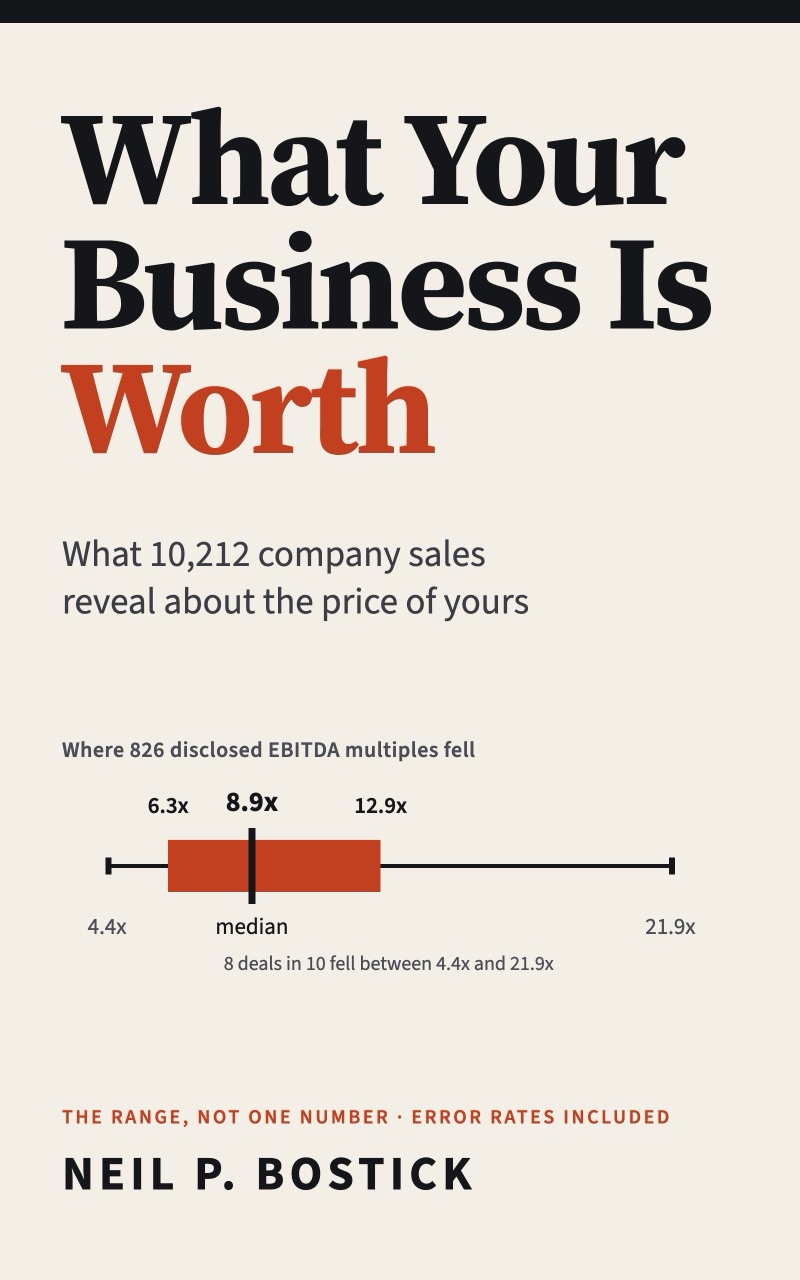
- A multiple is a range, not a number. The middle half of 826 disclosed EBITDA multiples runs from 6.3x to 12.9x; eight deals in ten fall between 4.4x and 21.9x. Chapter 1
- Main Street sells on SDE. In the Q2 2026 Market Pulse survey, advisors reported about 2.0x SDE below $500,000 of price, 2.8x up to $1 million and 3.1x up to $2 million. Chapter 3
- Size pays, once the censoring trap is removed. The median EBITDA multiple rises from 7.0x for businesses with $1 million to $3 million of EBITDA to 10.25x for those with $10 million to $30 million. Chapter 5
- Valuations miss. Priced from the median of its sector, a deal's estimate was off by a factor of two or more in about a quarter of cases. The author's own blended model, tested on deals it had not seen, missed by 3x or more 6.6% of the time. Chapter 7
- For an SBA-financed buyer, the lender sets the ceiling. With a 1.25x coverage rule, moving the interest rate from 6.15% to 10.25% cuts the maximum supportable price in a worked example by about $540,000, or 16%. Chapter 9
Every table behind these figures is on the book data page, with its sample size. The live archive is on Comparables, and the per-sector buyers on Who buys what.
Contents
Table of contents
- How to Read This Book
- Introduction: The Number Every Owner Wants
Part One: The Number
- 1How Much Is My Business Worth? Start With the Range
- 2SDE, EBITDA and the Earnings a Buyer Will Pay For
- 3Main Street: What Businesses Under $2 Million Sell For
- 4Multiples by Industry, With the Sample Sizes
Part Two: What Moves the Number
- 5Does Size Matter? The Censoring Trap and the Real Premium
- 6Margins, and Why Revenue Multiples Mislead
- 7How Wrong Can a Valuation Be?
Part Three: The Buyers
- 8Who Buys, and What They Buy
- 9The Debt Ceiling: How Lenders Cap the Price
Part Four: The Deal
- 10Price Versus Terms: Earnouts, Seller Notes and Rollover Equity
- 11Asset Sale or Stock Sale: Taxes at a High Level
- 12Getting a Valuation Done Properly
Part Five: The Exit
- 13Markets Move: Timing the Sale and the Boomer Exit Wave
- 14Preparing for Sale: What Actually Moves the Number
- Appendix A: How the Data Was Analyzed
- Appendix B: Multiples and Acquirers by Industry
- Appendix C: Worksheets and Checklists
- Appendix D: Glossary
- Selected Sources
- About the Author
Author
About the author, and his interests
Neil P. Bostick founded FIH, a lower-middle-market M&A advisory firm that works for owners of privately held technology companies when they sell, and operates FairlyValued.com, which publishes the comparables archive analyzed in the book.
Disclosure: his businesses earn fees when owners sell and when valuations are prepared, so he has a stake in what owners believe their businesses are worth. He also earns royalties on every copy of the book sold, including through the Amazon links on this page. That stake is why the book reports how often comparable-sales valuation misses, including the error rate of his own model, alongside the medians.
FAQ
Frequently asked questions
Will this book tell me what my business is worth?
No. No book can value a particular business. It shows the evidence a valuer, buyer or lender will use (the range of multiples, the earnings measure, size, margin, buyer type and financing) so that you can judge any number you are given. For a figure on your own business you need a credentialed appraiser; Chapter 12 explains what to ask for.
Does the data cover small businesses?
The archive's deals all have a value between $1 million and just under $1 billion, so it holds no Main Street sale. For businesses selling under $2 million the book uses the Market Pulse survey of business brokers and M&A advisors, priced on SDE, and says clearly which source covers which size.
What is the difference between SDE and EBITDA?
SDE (seller's discretionary earnings) adds one owner's entire pay and benefits back into profit; EBITDA assumes the business pays a manager at a market wage. SDE is the larger figure for the same business, so SDE multiples look smaller. Chapter 2 works an example.
How current is the data?
The comparables archive covers deals dated 2 September 2014 to 1 July 2025 and was analyzed as of 1 October 2026. The SBA rules described are SOP 50 10 8.1, effective 1 October 2026; the Main Street figures are from the Q2 2026 Market Pulse survey.
Is the book independent?
The author's firm earns fees from business sales and valuations, he operates this site, and he earns royalties on every copy sold. The book discloses the first two on its opening pages and reports error rates, including his own model's, so that readers can weigh the evidence themselves. It is general education, not an appraisal or tax, legal, lending or investment advice.
Where are the data and corrections?
On the book data page, with every analysis table and any corrections.
General education, not an appraisal or tax, legal, lending or investment advice.
Talk to an adviser about a sale
Considering a sale?
A benchmark range is a starting point, not an answer. If you want a considered view on what your business would actually fetch, and what to fix first, an adviser at FIH.com will talk it through. No upfront fees; they are paid on completion.
Want a considered answer this week?
$495Sixty minutes with a senior adviser on what the business is worth, who would buy it, and what to fix first. Credited in full against our fee if you engage us.
Book an advisory session